

The €75 billion in EU 2021–2027 funds: let's spend them wisely
Series: Scenarios — Italy after the NRRP | Article 1
When the PNRR closes, emergency-mode EU funding ends with it. The tight deadlines, fast-tracked reporting and top-down priorities give way to ordinary, structural, multi-annual programming. But does Italy's public administration have the spending capacity to make it work?
From Extraordinary to Ordinary Programming: An Opportunity Not to Be Missed
When the National Recovery and Resilience Plan (PNRR) officially comes to an end on 31 August 2026, Italy will find itself facing an uncomfortable reality. For four years, the €194.4 billion made available through the Plan have masked a structural weakness that the country has yet to address.
According to the Seventh Report to Parliament on the State of PNRR Implementation published by the PNRR Mission Structure in January 2026, as of 30 November 2025, actual expenditure incurred by the responsible public administrations amounted to €101.3 billion: 52% of the allocated resources, compared with €153.2 billion already disbursed by the European Commission, representing 78.8% of the total.
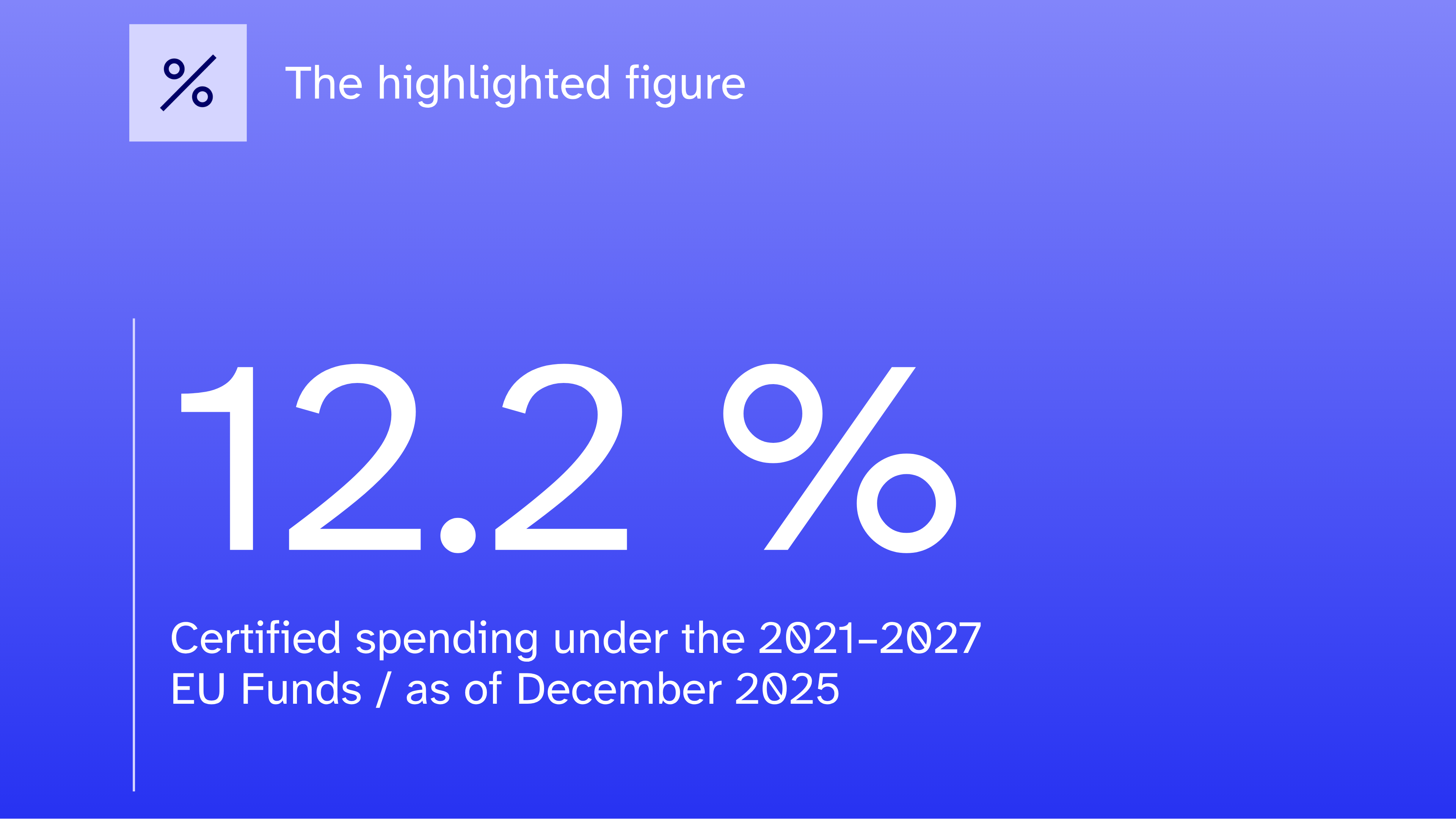
But what remains available, and what opportunities lie ahead? The 2021–2027 Structural Funds still offer significant room for action. With €75 billion in European funding and national co-financing - the ERDF, ESF+, JTF and EMFAF allocation provided under the Italy 2021–2027 Partnership Agreement - and with the first expenditure certification deadline of 31 December 2025 already exceeded (Italy certified €8.9 billion, surpassing the EU target of €3.6 billion), local public administrations are now entering the most demanding phase of the programming cycle, with final reporting due by 2030. Several regions, particularly in Southern Italy, have already accelerated the implementation of ERDF and ESF+ programmes to offset the gradual phase-out of the PNRR. This is an encouraging sign, although the administrative capacity to turn commitments into completed projects remains the main bottleneck.
Negotiations for the 2028–2034 Programming Period
Negotiations in Brussels on the next 2028–2034 Multiannual Financial Framework (MFF) are already well underway. The European Commission presented its proposal in July 2025, and Italy is actively participating in discussions between the so-called frugal countries—which support redirecting resources towards defence and strategic capabilities - and highly indebted countries such as Italy, Spain and several Eastern European Member States, which continue to defend cohesion policy as a key instrument for promoting European convergence.
In this context, the end of the PNRR is not simply the loss of an extraordinary funding instrument: it is also a test of maturity for the Italian public administration. Italy’s negotiating credibility in the 2028–2034 MFF will depend on its demonstrated ability to effectively manage and spend the ordinary 2021–2027 Structural Funds, rather than on the PNRR itself, which concludes as a standalone instrument. If Italy successfully certifies expenditure and completes the planned reforms, it will have a stronger voice in shaping the rules of the next 2028–2034 cohesion policy cycle.
Local Public Administration Under the Pressure of the Stability and Growth Pact
For municipalities, provinces and regions, the challenge is twofold. They must absorb the €75 billion available through the 2021–2027 Structural Funds within tight deadlines. This represents a critical test for a country that, during the 2014–2020 programming period, met its expenditure targets only thanks to a final-year acceleration, certifying €10.5 billion out of the total €47 billion in the last eligible year, under the pressure of the automatic decommitment rule, which requires unspent EU funds to be returned to Brussels. At the same time, they must do so within the constraints of the reformed Stability and Growth Pact, adopted in 2024, which requires highly indebted Member States to achieve a minimum annual structural adjustment of 0.5% of GDP. ANCI has already raised its concerns, calling for no additional quantitative restrictions on municipal budgets, particularly regarding public investment and social expenditure. The paradox is clear: local public administrations are being asked to do more with fewer resources.
.png)
The Growth of Zero Point Something…
Are we heading towards stagnation? It is too early to say, but the projections of the most authoritative institutions converge on a scenario of sluggish growth.
In its latest June 2026 projections, the Bank of Italy forecasts Italian GDP growth of 0.5% in 2026, 0.4% in 2027, and 0.9% in 2028, revising its December 2025 estimates downward by around half a percentage point. The revision is mainly driven by rising energy prices linked to the conflict in the Middle East. ISTAT, in its June 2026 report, is more optimistic, forecasting 0.7% growth in both 2026 and 2027, supported by domestic demand despite the negative contribution of net external demand, also affected by the conflict in the Middle East and higher energy costs.
The Investment Gap
The most critical issue is the investment gap that the PNRR leaves behind.
According to Bruegel's 2024 estimates, the green and digital transition alone requires the European Union to mobilise at least €481 billion in additional investment every year until 2030—not a cumulative figure, but a recurring annual investment need on top of already planned spending.
However, the Draghi Report (September 2024) broadened this estimate, raising the annual requirement to €750–800 billion in additional investment to ensure Europe's competitiveness, energy transition and defence capabilities. Italy has also used the Recovery Fund as a substitute for a public investment policy that has remained weak for decades. Without that lever, the risk is not only slower growth, but also the country’s inability to continue modernising.
What's Next
In the next article, Civiqa will examine the issue of administrative capacity: how many Italian municipalities actually have the expertise needed to manage the Structural Funds? What are the main challenges in the reporting process, and how can they be addressed? What are the differences between Northern and Southern Italy? As we will see, the figures are even more concerning than the GDP forecasts.
.png)