

DOCFAP: the tool that helps public authorities invest wisely
.png)
Imagine that a municipality needs to renovate a school. It can carry out major maintenance works, undertake an extensive refurbishment, or demolish and rebuild the building entirely. These are three very different options in terms of costs, timing and impact on the local community. Until just a few years ago, there was no formal requirement to compare these alternatives before making a decision.
Today, there is.
The DOCFAP (Documento di Fattibilità delle Alternative Progettuali – Feasibility Study of Design Alternatives) is the document through which the RUP (Project Manager) compares multiple investment scenarios before selecting the preferred option. Under the new Public Contracts Code, this comparison has become mandatory for an increasing number of public works projects—and remains recommended even when not legally required.
DOCFAP: what changes for the Project Manager (RUP)
The DOCFAP is the document that compares design alternatives for a public investment before the technical design phase begins: a new preliminary step to the PFTE that strengthens the decision-making process for public spending choices.
For the RUP (Single Project Manager) it is not just another administrative requirement: it is the moment when an investment decision is justified and made sustainable over time. The DOCFAP shifts the focus from mere technical design to the quality of decisions, requiring that every project – whether for schools, roads, facilities, or public buildings – be evaluated based on objective criteria, with clear justifications, measurable results, and an explicit link to the impacts on the community and the organization's budget.
The change is more profound than it may seem. In many administrations, the process followed an informal logic: first you decided, then you documented. With the DOCFAP, this approach is reversed: documentation accompanies the decision-making process from its earliest stages. And it is precisely in this transition that the main operational difficulties emerge, which can, however, be resolved with the right tools.
Operational challenges for the RUP: where the process gets stuck
Regarding the seven sections (a–g) provided for by Article 2, paragraph 4 of Annex I.7 to Legislative Decree 36/2023, the greatest difficulties in drafting the DOCFAP are concentrated in the central sections: those dedicated to costs, benefits, risks, and the comparison of alternatives, which require indicators such as NPV (Net Present Value), IRR (Internal Rate of Return), C/B (Cost/Benefit) ratio, and sensitivity analysis.
In this regard, we have found that, especially in less structured municipalities, five critical issues recur most often:
- lack of technical-evaluative skills
- fragmented and misaligned data
- estimation of parametric costs for works
- discontinuity between DOCFAP and PFTE
- robust and defensible evidence.
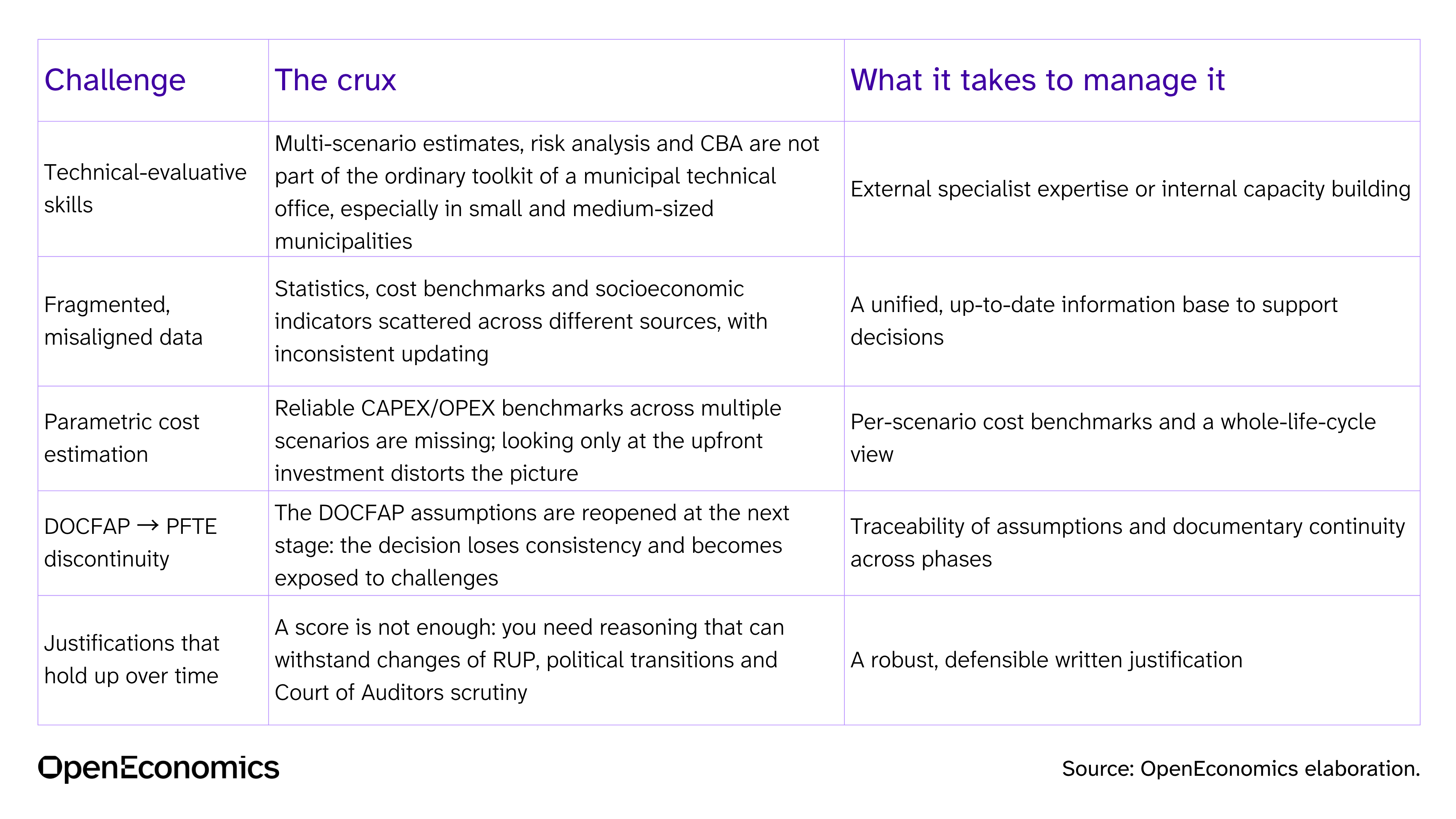
This is why the DOCFAP is currently one of the most sensitive points in the public investment cycle, but also the one that can offer the greatest return in terms of transparency and accountability.
Next-generation tools for the DOCFAP: methodology built-in
How can you tackle the challenges of drafting a DOCFAP?
A new generation of platforms for public spending management is on the way: the methodology for comparison—cost-benefit analysis, risk analysis, and multi-criteria analysis—is integrated directly into the DOCFAP module, so officials don't have to set it up from scratch.
Key benefits include: cost benchmarks are already aggregated from public sources, as is contextual data; and the transition from DOCFAP to PFTE happens without any manual re-entry.
This is the direction OpenEconomics is taking with Civiqa: a dedicated DOCFAP module will guide officials through the seven required sections, from cost estimation to the final justification. We will look at this in detail in an upcoming article.
Frequently asked questions about drafting the DOCFAP
What is the DOCFAP?
The DOCFAP (Feasibility Document for Project Alternatives) is the document used by the
Project Manager (RUP) to compare multiple public investment options—including the costs, benefits, and risks of each—before deciding which one to implement. It is governed by Annex I.7 of Legislative Decree 36/2023.
Who drafts the DOCFAP?
The DOCFAP is drafted under the responsibility of the RUP (Sole Project Manager),
who may rely on internal or external technical support for the economic and
risk analyses required by the seven mandatory sections of the document.
When is the DOCFAP mandatory?
The DOCFAP is mandatory for works above the EU threshold (€5,538,000) when
multiple technical or location alternatives are viable. It is optional between €150,000 and
the EU threshold, and not required for supplies, services, and routine maintenance - but
it remains recommended even in non-mandatory cases.
Why is it advisable to prepare a DOCFAP even when it is not mandatory?
Preparing a DOCFAP is beneficial because it makes investment decisions defensible before the Court of Auditors and during audits, highlights long-term costs (CAPEX and OPEX), strengthens applications for European and national funding, and ensures continuity during changes in administration: it transforms a decision from an opinion into sustainable evidence.

.png)
.png)